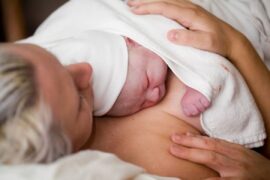
Loving our postpartum bodies isn’t something that comes easy to everyone. Such huge changes in our physicality as a result of growing and birthing a baby can be difficult to integrate, especially in a world designed to promote and celebrate the lithe, sexy, toned bodies of celebs and other famous people. Photographer Natalie McCain created The Honest Body Project specifically to help women learn to love their bodies and share their stories, and since then has created another project, this time celebrating the breastfeeding of our toddlers.
The Honest Body Project as a whole is about showing women how beautiful they are, exactly as they are. “As a family photographer, I was constantly being asked to Photoshop the women I photographed,” McCain says. “It always broke my heart. I saw their beauty as they were, yet women struggle to see it within themselves. I wanted to help women learn to have a healthy body image and self-love.”
Back in 2015, she had an idea and vision for The Honest Body Project, but needed a willing participant to kick things off. She asked a good friend to come over to her house, and let her photograph her in her underwear. Immediately, she knew there was a huge amount of power and beauty in the portraits.
“After I photographed her, I wept while going through her images,” she says. “I saw her beauty, strength and soul. I didn’t see any imperfections. I posted the images on social media and suddenly had hundreds of women wanting to take part. Every woman has a story to share and I am honored to share them.”
After she photographs the women, she has them write to her to tell her their stories.
“America tends to view breasts as being sexual. This view places a stigma on breastfeeding, and especially on extended nursing. For those who have never nursed a toddler, it is difficult to understand why a mom would choose to continue to nurse beyond infancy. It is common for mothers to wean their children in a way and time that conforms to their societal norms. America is not supportive of extending nursing. That differs across the world. In most other countries, weaning isn’t expected until even beyond the toddler years. I hope America makes to it that point someday. I would love to see our country as one that supports and encourages breastfeeding and natural, gentle methods of weaning.”
“I ask them to speak from the heart, no limitations,” she says on her website. “The raw stories they provide are the backbone of this project. The portraits show their joy, their beauty, their imperfections, and their love for their children. Paired with their stories, it paints a beautiful, honest picture of motherhood.”
Since then, she has turned her lens toward breastfeeding, and more specifically – breastfeeding toddlers.
“Growing up I only remember seeing one person in my life who nursed their child, it was my Aunt Cindy. I remember everyone giving her a hard time because she nursed her youngest son until 18 months. I have sent her several messages and thanked her for being such a positive example of breastfeeding in my life. I’m thankful that I had at least one person to show me what nursing was growing up.”“I began having kids before many of my friends. As they watched my nursing relationship progress, they would say things like, “It’s fine to breastfeed as long as …” As long as he doesn’t have a mouth full of teeth. As long as he isn’t walking. As long as he can’t ask for it. As long as he can’t pull up your shirt. As long as he isn’t 2, or 3, or … In hypothetical conversations, before I was at those milestones, their statements seemed logical. In reality, as my child(ren) grew, it seemed ridiculous to end a nursing relationship based on any of these factors. Why was nursing yesterday fine, but today he is too old? I also think that as I continued learning along the way, so did those around me. They realized that it wasn’t so ‘weird’ that my child continued to breastfeed. People no longer make those sorts of comments to me, even though it is well known that I nurse full-term. Maybe their sense of normal has evolved alongside their own experiences or maybe they have just resigned themselves to the fact that we all parent in our own way, doing what is best for our own family.”
See next page for more amazing photos and stories…
Used only with old Urchin versions of Google Analytics and not with GA.js. Was used to distinguish between new sessions and visits at the end of a session.
End of session (browser)
__utmz
Contains information about the traffic source or campaign that directed user to the website. The cookie is set when the GA.js javascript is loaded and updated when data is sent to the Google Anaytics server
6 months after last activity
__utmv
Contains custom information set by the web developer via the _setCustomVar method in Google Analytics. This cookie is updated every time new data is sent to the Google Analytics server.
2 years after last activity
__utmx
Used to determine whether a user is included in an A / B or Multivariate test.
18 months
_ga
ID used to identify users
2 years
_gali
Used by Google Analytics to determine which links on a page are being clicked
30 seconds
_ga_
ID used to identify users
2 years
_gid
ID used to identify users for 24 hours after last activity
24 hours
_gat
Used to monitor number of Google Analytics server requests when using Google Tag Manager
1 minute
_gac_
Contains information related to marketing campaigns of the user. These are shared with Google AdWords / Google Ads when the Google Ads and Google Analytics accounts are linked together.
90 days
__utma
ID used to identify users and sessions
2 years after last activity
__utmt
Used to monitor number of Google Analytics server requests
10 minutes
__utmb
Used to distinguish new sessions and visits. This cookie is set when the GA.js javascript library is loaded and there is no existing __utmb cookie. The cookie is updated every time data is sent to the Google Analytics server.