
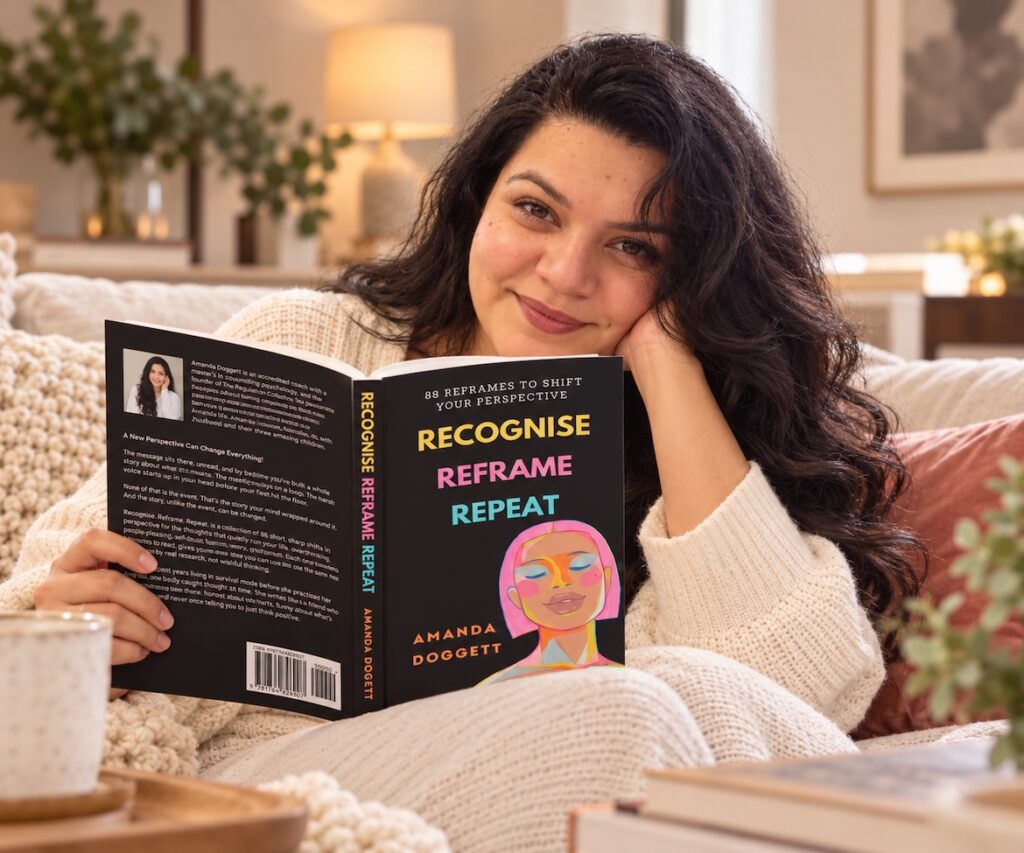
By Amanda Doggett, author of Recognise. Reframe. Repeat.: 88 Reframes to Shift Your Perspective
My eldest loves plain pasta. I could cook the most highly rated recipe on the internet, take her to a beautiful restaurant, put something extraordinary in front of her and she’d still ask for plain pasta. No sauce. No suspicious green bits. Nothing that suggests someone got carried away with a cookbook.
For years, I took this personally. I’d made an effort. Surely a recipe existed that would make her appreciate it. Then it hit me: she wasn’t reviewing my motherhood. She wanted pasta. I’d been serving dinner with an invisible side of please confirm I’m doing a good job. She hadn’t ordered that.
You might have your own version. The family outing that costs a small fortune, only for the kids to declare the best bit was the chips. The child whose educator describes them as “so helpful”, while at home you can’t get them to carry a sock. You’re pleased, obviously. You’d just like to meet this helpful child occasionally.
Somewhere between the effort and the disappointment, an ordinary parenting problem becomes a personal conclusion: Nothing I do is enough.
There’s what actually happened, and then there’s what we decided it meant. We tend to experience them as the same thing. Separating them is where a reframe begins.
A reframe is another honest way of understanding the same situation. My daughter didn’t want her dinner. That was the fact. My effort means nothing was the story I’d attached to it. When I considered that her preference might have very little to do with me, dinner became a food problem again. Still inconvenient. Considerably less heartbreaking.
That’s the idea behind my book, Recognise. Reframe. Repeat.: 88 Reframes to Shift Your Perspective. You look again at your conclusion and ask whether it’s fair, accurate, or the only explanation available. You haven’t changed what happened. You’ve given yourself another way to respond.
Take the morning shoe situation. You’re late, you’ve asked four times, and your voice has reached the stage where each word gets its own sentence. “Put. Your. Shoes. On.” Meanwhile, your child has found time to investigate a dead moth.
They’re doing this to make my life difficult gets you ready for a fight. Something about this is difficult for them gives you a reason to get curious. Perhaps the sock feels wrong. Perhaps stopping their game is hard. You can help with that and still insist on leaving. Nobody’s suggesting you ring the school and explain that shoes are no longer aligned with your family’s values.
Now, don’t get me wrong. Reframing isn’t smiling through everything. You don’t have to survive three hours of broken sleep and announce that you feel blessed. You can adore your children and want eleven minutes without anyone touching you or asking for a snack.
It also isn’t a way to make an unfair workload more bearable so you can keep doing all of it. “I need help, and we need to change how this works” might be the most useful reframe available. Someone still needs to unpack the dishwasher. Preferably someone who hasn’t just asked you where every plate goes.
The new perspective has to be believable. “Everything is wonderful” is a difficult argument to maintain while scraping Weet-Bix off a wall. “This is hard, and I can deal with one part at a time” gives you somewhere to begin.
Often, the story that needs questioning is about the mother we think we should be. I have a version of myself on file who slept properly, had no deadlines and somehow had three cooperative children. Patient woman. Lovely company. I keep expecting her to turn up at five o’clock on a Thursday under entirely different conditions.
But your best is a peak, not a postcode. You can’t move in. That unusually good day cannot become the minimum standard for every Tuesday afterwards. “What’s manageable with what I have today?” might lead to a simpler dinner or an earlier request for help. It’s a fairer question than “Why can’t I cope?”
So here’s what I’d love you to try tomorrow. Pick one familiar flashpoint: dinner, bedtime, getting out the door. Write Fact. Story. Next. on a scrap of paper and stick it near the kettle. Think of it as Recognise. Reframe. Repeat. in pocket size. No new journal required. We’ve all got enough lovely notebooks we’re saving for when we become different people.
When that moment comes, ask yourself: What actually happened? What am I telling myself it means? What else could be true, and what can I do next? With dinner: “She doesn’t want this food. I’m taking it as rejection. She may simply want something familiar. I can decide what happens with dinner without deciding I’m a failure.”
Try it once. If you only remember afterwards, start there. Remembering a good idea while reading and remembering it while someone shouts “MUM” from the toilet are different achievements. You’ll get more practice. Children are generous like that.
I put 88 reframes in the book for people who don’t get to finish books. It’s for the overthinker, the people-pleaser, the parent stuck in guilt and the one running on empty. Each reframe stands on its own, with something you can try that day. It reached Amazon’s Top 50 best sellers in Psychology of Emotions, but what I love most is hearing from readers who finally questioned a thought they’d carried for years.
Reframing is an everyday skill, not a replacement for professional care. If anxiety or low mood is hanging around, for you or your child, please talk to your doctor or someone trained to help.
For now, choose that one moment. Before you turn it into evidence against yourself, check the story. You already have a child to help, a limit to hold or a mess to clean. You don’t need to put your whole motherhood on trial as well.
Sometimes it’s just the pasta.
Amanda Doggett is an author, coach and AI strategist, and the founder of The Regulation Collective. She holds a Master’s in Counselling Psychology, and her work is coaching and education. Find her at amandadoggett.com.