By Camilla Van Rosendal
The Weight of Her
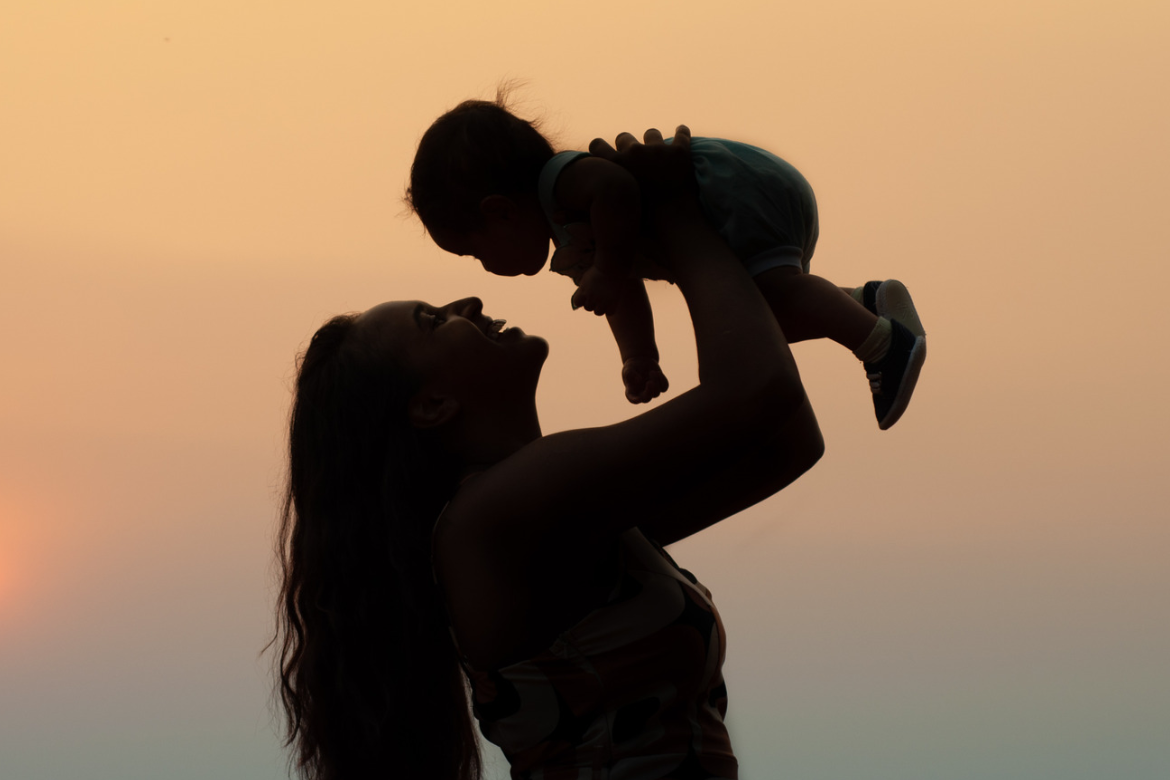
Sometimes, when her father lifts her to dance, my daughter folds herself into the shape of a baby.
She turns her body inwards, settling her head into the crook of his arm while his other arm comes beneath her bottom. I recognise the arrangement almost instinctively, the familiar curve of her body as she relinquishes its weight.
Only now there is so much more of her.
Her legs extend well beyond his arms, and he gathers her closer to his chest to accommodate the length of her. From where I sit on her bed, I watch him begin to sway.
This is how our evenings end. Sometimes she dances with her arms around his neck, her legs wrapped around his waist or swinging freely as he moves. Other nights, she assumes that familiar position of infancy. When their dance is finished, he brings her to the bedside and lowers her towards me. I lie with her until she falls asleep.
Once, it was me who danced her to sleep.
I knew the particular heaviness of her head as she drifted out of wakefulness, the warmth that gathered between our bodies, the delicate business of slowing my movements without disturbing her. There were evenings when I could feel the ache travelling from my arms into my shoulders and would bargain silently with her sleeping body for permission to put her down.
I cannot remember the last time we danced at bedtime.
Somewhere in the intervening years, her body grew beyond the comfortable reach of my arms, and our evenings took on a different shape. For a while, the dance disappeared. Sometime in the past year, she found her way back to it in her father’s arms.
She remembers being danced to sleep. I had imagined those early dances belonged mostly to my memory, and there is something deeply moving about discovering that she has kept a little of them for herself.
But lately, watching her with her father, I have found myself less preoccupied with how much she has grown than with something she has yet to lose.
There is no hesitation in the way she gives her weight to him. She makes no attempt to distribute it more evenly, to make herself easier to carry. She settles into his arms with the assurance that there is room for the whole of her.
There is an ease in that gesture that I find increasingly difficult to recognise in myself.
In the ordinary moments when help is offered, the words No, it’s okay, I’ve got it often arrive before I have given any real consideration to whether I have.
There is something almost imperceptible about this kind of self-denial. No single instance seems particularly consequential. Only in their accumulation do we begin to see how thoroughly we have learnt to make ourselves manageable.
Motherhood has revealed a capacity within me that I could scarcely have imagined before becoming a mother. The physical endurance, the emotional elasticity, the ability to continue giving of myself through circumstances in which I might once have believed I had nothing left to give.
There is much about that capacity that I am proud of.
But the knowledge that I can withstand something can so easily become a reason to continue withstanding it. Resilience can quietly become a tolerance for circumstances that diminish us.
Our resilience can give us the courage to change the conditions of our lives. Yet it can also be the very quality that enables us to remain within the conditions that ought to change.
So much of what is celebrated in women is our capacity to absorb. We are praised for managing extraordinary amounts, and the praise itself can make it difficult to admit that something has become too much. Over time, we may even begin to assess the legitimacy of our own needs against our capacity to go without them.
If I can manage, perhaps I should.
How many women have built entire lives around that quiet calculation?
My daughter has recently begun returning things to me that I had forgotten giving her.
We have spoken often about the passing of difficult feelings. When something has upset her, I have tried to help her understand that what she felt was real, but that a new day need not be lived entirely in the company of the one before it.
Not long ago, I was still talking about something that had happened the previous day. I had returned to it several times, occupying myself with something that was no longer happening.
That was yesterday, she reminded me. Today is today.
What surprised me was her understanding of when to offer those words. Somewhere between hearing them from me and offering them back, she had made them her own. I had been so accustomed to helping her understand her experience of the world that I hadn’t quite anticipated the moment she would begin helping me understand mine.
It has made me wonder what else she is noticing.
I spend so much of motherhood encouraging my children to recognise their needs. I want them to tell me when something hurts, when they are tired, when something feels unfair. I want them to understand that their discomfort deserves attention, even when it is inconvenient to someone else.
There is a quiet contradiction in raising children to honour their needs while living in ways that suggest our own are negotiable.
My daughter may begin to understand womanhood through the small accommodations she witnesses me making, long before we ever have a conversation about what it means to be a woman. What will she make of that discrepancy when she becomes old enough to recognise it?
She is four, and already there are things she understands that catch me entirely off guard. She seems to feel no obligation to outgrow a tenderness simply because she has become capable of more.
There is something worth preserving here. In our eagerness to nurture all that our children are growing into, we could afford to pay closer attention to the things we hope they never grow out of.
I want my daughter to become a woman who knows the extent of her own strength. I want her to trust her ability to navigate difficulty, to recover from disappointment, to stand firmly within herself when the world asks her to do otherwise.
But I want that strength to serve her, too.
I don’t want her to spend her childhood learning how to carry herself, only to spend her adulthood learning how to let herself be held.
The difficulty is that I am still learning these things myself.
Even now, I find it easier to justify caring for myself through what it enables me to give to others. Rest becomes more permissible when I can imagine the more patient mother I might be afterwards. Time alone becomes easier to defend when I can explain how it will benefit my family.
Rarely do I allow the need itself to be sufficient.
There is something painful about recognising how deeply motherhood can become entangled with our sense of deserving. Even the work of returning to ourselves can become another thing we undertake in service of our children.
My daughter may learn something valuable from witnessing me receive tenderness. But there is a woman beneath that lesson who deserves to receive it, regardless of what anyone learns from her.
Tonight, my husband dances with our daughter again. Her cheek rests against his chest, her feet suspended above the floor.
When he comes towards the bed, I reach for her. For a brief moment, before he withdraws his arms, we are both holding her.
She settles beside me, drawing herself into the warmth of my body. There is nothing tentative about the closeness she seeks. She has not yet learnt to consider whether she is asking for too much.
I hope she never does.
She falls asleep. I stay a little longer, listening to the rise and fall of her breath. And I wonder how old I was when I began making myself lighter.
Camilla van Rosendal is a writer, mother and author of Scatter to Bloom: Conversations with My Intuition. Through the Peaceful Mama Project, she explores matrescence, intuition and the unseen emotional architecture of family life. Her writing examines questions of identity, belonging and the cultural and inherited narratives that shape women’s experiences of motherhood.